
Types of precipitation
Rainfall is the most common form of precipitation, occurring when atmospheric water vapor condenses around hygroscopic nuclei and falls to the Earth’s surface in liquid form under the influence of gravity. It is a critical component of the hydrological cycle, responsible for the distribution of freshwater across global ecosystems. Based on the mechanism of air ascent and the origin of cooling, rainfall is broadly classified into three types: Convectional, Orographic (Relief), and Cyclonic (Frontal).
Convectional rainfall:
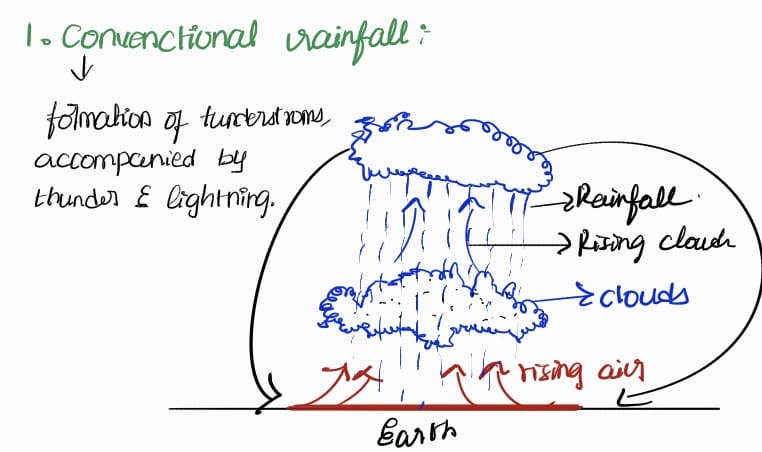
1. The Mechanism
-
Insolation & Heating: During the day, the Earth’s surface is heated intensely by the sun. This heating is most effective in regions where the sun’s rays are vertical (Equator).
-
Air Expansion: The air in contact with the hot ground gets heated, expands, and becomes lighter.
-
Convection Currents: This light, warm air rises in the form of vertical convection currents.
-
Adiabatic Cooling: As the air rises, it moves into layers of lower atmospheric pressure, causing it to expand and cool. This process is called adiabatic cooling.
-
Condensation: Once the air reaches its Dew Point (saturation), moisture condenses around dust particles, forming massive vertical clouds—Cumulonimbus.
- Precipitation: The heavy moisture eventually falls as torrential rain, often accompanied by thunder and lightning.
2. Major Characteristics
-
Intensity: It is usually torrential (heavy) but of short duration.
-
Time of Day: It typically occurs in the afternoon (around 4 PM) after the peak heating of the day. This is why it is often called “4 o’clock rain.”
-
Associated Weather: Frequently accompanied by thunder, lightning, and sometimes hail.
-
Localized: It is highly localized, meaning it might be raining heavily in one spot while a few kilometers away it is dry.
-
Cloud Type: Always associated with Cumulonimbus clouds (clouds of great vertical extent).
3. Geographical Distribution
-
Equatorial Regions: The most prominent region is the Doldrums (0° to 5° N/S). Areas like the Amazon Basin, Congo Basin, and South East Asian Islands receive this rain almost daily throughout the year.
-
Tropical/Sub-tropical Interiors: During summer, the interiors of continents (e.g., central parts of India or the USA) experience convectional showers.
-
India Context: In India, pre-monsoon showers like Kal Baisakhi (West Bengal) and Bordoisila (Assam) are convectional in nature.
4. Significance
-
Ecology: Supports the growth of Tropical Evergreen Forests (Rainforests) due to the daily supply of moisture.
-
Agriculture: While intense, it is often too localized and violent for systematic irrigation, but it helps in maintaining soil moisture in tropical belts.
-
Comparison: Unlike orographic rain (which is persistent) or cyclonic rain (which covers large areas), convectional rain is a “quick-burst” mechanism.
Orographic (Relief)
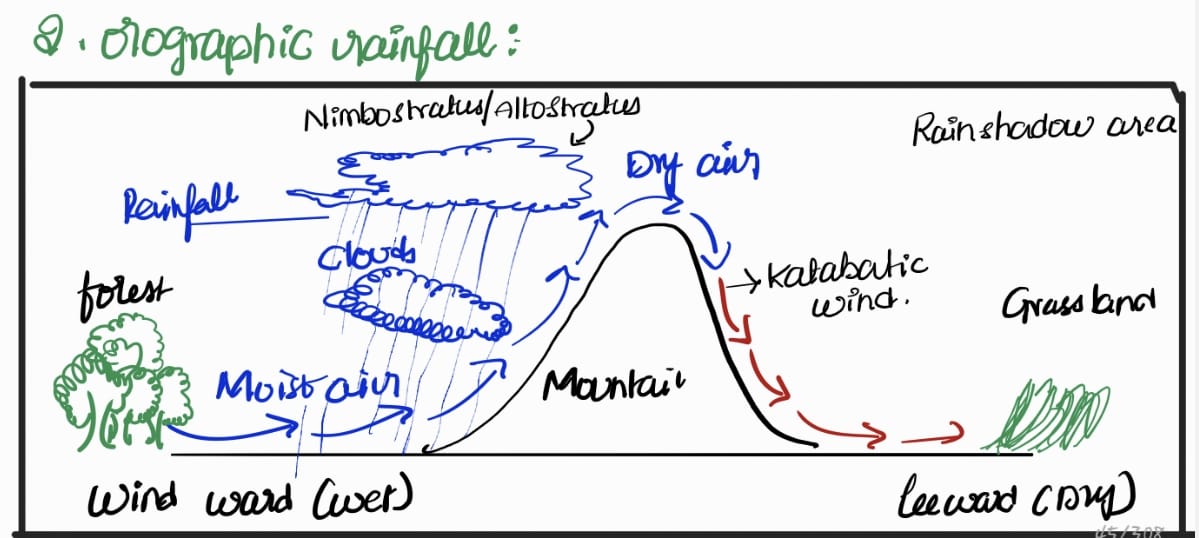
In Geography, Orographic Rainfall (also known as Relief Rainfall) is the most common form of rainfall globally. It is caused by the physical features of the Earth’s surface, such as mountain ranges, which act as barriers to moisture-laden winds.
In Geography, Orographic Rainfall (also known as Relief Rainfall) is the most common form of rainfall globally. It is caused by the physical features of the Earth’s surface, such as mountain ranges, which act as barriers to moisture-laden winds.
1. The Mechanism
The process is driven by the upward movement of air forced by topography:
-
Air Strike: Warm, moist air (often from the ocean) hits a mountain range or a plateau.
-
Orographic Lift: The air is forced to rise along the slope of the mountain.
-
Adiabatic Cooling: As the air rises, it expands and cools due to the decrease in atmospheric pressure at higher altitudes.
-
Condensation & Rain: Once the air reaches its dew point, water vapor condenses into clouds, leading to heavy precipitation on the windward side (the side facing the wind).
-
Descent & Warming: After crossing the peak, the air (now dry) descends the other side. As it descends, it is compressed and warms up (Adiabatic Warming), which increases its moisture-holding capacity and prevents rain.
2.Key Terms for UPSC
-
Windward Side: The slope of the mountain that faces the prevailing moisture-laden winds. It receives heavy rainfall and is often covered in lush vegetation.
-
Leeward Side: The slope sheltered from the wind. It receives very little rainfall.
-
Rain Shadow Area: The dry region on the leeward side. For example, the Deccan Plateau in India lies in the rain shadow of the Western Ghats.
-
Katabatic Winds: The dry, warm winds that descend the leeward slope (often called “mountain eaters” like the Chinook in the Rockies).
3. Case Study: India
The Western Ghats provide a textbook example of orographic rainfall in India:
-
Windward Side: The Arabian Sea branch of the Southwest Monsoon hits the Western Ghats. Cities like Mumbai and Mangalore receive very high rainfall (over 250 cm).
-
Leeward Side: Places like Pune and Mahabaleshwar, though relatively close to the coast, receive significantly less rain because they lie on the leeward side.
-
Mawsynram/Cherrapunji: These receive the highest rainfall in the world because they are surrounded by the Khasi Hills, which trap moisture-laden winds and force them to rise abruptly.
Cyclonic Rainfall
Cyclonic Rainfall, often referred to as Frontal Rainfall, is caused by the convergence of contrasting air masses or the formation of low-pressure centers. In the UPSC syllabus, it is crucial to distinguish between its two forms: Tropical and Temperate.
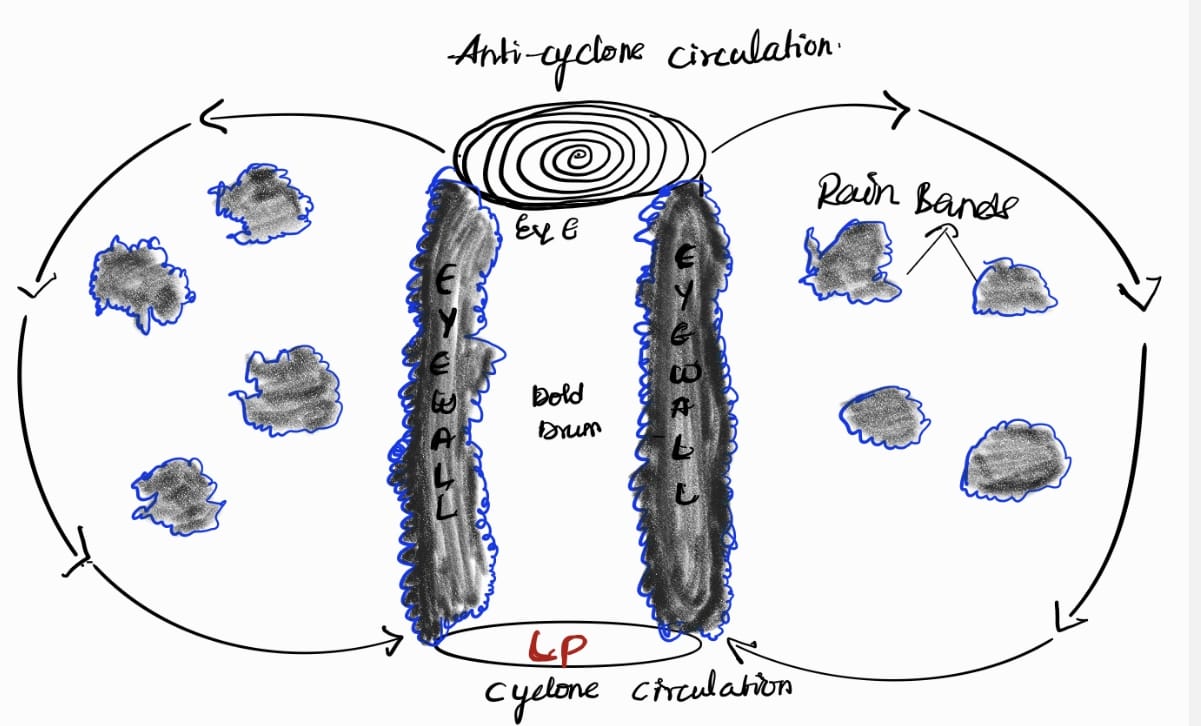
1. Mechanism of Action
The fundamental principle behind cyclonic rainfall is the lifting of warm air due to atmospheric disturbances:
-
Frontal Ascent: In temperate regions, when a warm, light air mass meets a cold, dense air mass, the warm air is forced to rise over the cold air along a boundary called a front.
-
Adiabatic Cooling: As the warm air rises, it expands and cools adiabatically.
-
Condensation: Moisture in the rising air reaches saturation (dew point), leading to cloud formation and subsequent rainfall’
| Feature | Temperate (Extra-Tropical) | Tropical Cyclonic |
| Origin | Frontal (Collision of warm & cold air masses) | Thermal (Intense heating over warm oceans) |
| Latitude | Mid-latitudes ($35^\circ$ to $65^\circ$ N/S) | Tropical belt ($8^\circ$ to $20^\circ$ N/S) |
| Rainfall Nature | Slow, steady, and can last for days | Torrential, violent, and short-lived |
| Cloud Type | Stratus, Nimbostratus, Altostratus | Cumulonimbus (near the eye-wall) |
| Direction | West to East (Westerlies) |
|
3. Geographical Relevance to India
In the Indian context, cyclonic rainfall occurs in two distinct ways:
-
Tropical Cyclones (Bay of Bengal & Arabian Sea):
-
Occur mostly during the Retreating Monsoon (October–November).
-
Bring heavy rain and storm surges to the eastern coast (Odisha, Andhra Pradesh, Tamil Nadu).
-
-
Western Disturbances (Temperate Cyclones):
-
These originate in the Mediterranean Sea and travel eastward.
-
They bring winter rainfall to North and Northwest India (Punjab, Haryana, J&K).
-
Significance: This rain is vital for the Rabi crops, particularly wheat.
-
Mains (GS Paper 1),
Question
“Differentiate between the various types of rainfall based on their origin. Also, explain the ‘Rain Shadow’ effect with a suitable example from India.” (10 Marks, 150 Words.
Types of Rainfall – Prelims Practice Questions
Q1. Which of the following correctly matches the type of rainfall with its primary cause?
| Type of Rainfall | Cause |
|---|---|
| 1. Convectional | Orographic uplift |
| 2. Orographic | Forced ascent of moist air over mountains |
| 3. Cyclonic | Convergence of air masses |
Select the correct answer using the code below:
(a) 2 and 3 only
(b) 1 and 2 only
(c) 1 and 3 only
(d) 1, 2 and 3
Answer: (a)
Q2. Convectional rainfall is most commonly associated with which of the following regions?
(a) Mid-latitude deserts
(b) Equatorial regions
(c) Polar regions
(d) Mediterranean climate regions
Answer: (b)
Q3. Consider the following statements regarding Orographic rainfall:
-
The windward side of a mountain receives more rainfall than the leeward side.
-
Rain-shadow regions experience high humidity.
-
Western Ghats cause orographic rainfall in India.
Which of the statements given above are correct?
(a) 1 and 2 only
(b) 1 and 3 only
(c) 2 and 3 only
(d) 1, 2 and 3
Answer: (b)
Q4. Which type of rainfall is associated with frontal activity?
(a) Convectional rainfall
(b) Orographic rainfall
(c) Cyclonic rainfall
(d) Monsoonal rainfall
Answer: (c)
Q5. Cyclonic rainfall is generally characterized by:
(a) Short duration and high intensity
(b) Uniform rainfall over large areas
(c) Occurrence only in tropical regions
(d) Absence of cloud formation
Answer: (b)
Q6. In India, which type of rainfall is mainly responsible for rainfall along the Western Coastal Plains?
(a) Convectional rainfall
(b) Orographic rainfall
(c) Cyclonic rainfall
(d) Frontal rainfall
Answer: (b)
Q7. Which of the following pairs is/are correctly matched?
| Rainfall Type | Associated Cloud |
|---|---|
| 1. Convectional | Cumulonimbus |
| 2. Orographic | Stratus |
| 3. Cyclonic | Nimbostratus |
Select the correct answer:
(a) 1 only
(b) 1 and 3 only
(c) 2 and 3 only
(d) 1, 2 and 3
Answer: (b)
Q8. Rainfall caused due to intense surface heating leading to vertical ascent of air is known as:
(a) Orographic rainfall
(b) Cyclonic rainfall
(c) Convectional rainfall
(d) Frontal rainfall
Answer: (c)
Q9. Which one of the following statements best describes a rain-shadow region?
(a) Region receiving rainfall throughout the year
(b) Area on the windward side of mountains
(c) Area on the leeward side with low rainfall
(d) Region affected by cyclonic storms
Answer: (c)
Q10. The main cause of rainfall in temperate regions of Europe is:
(a) Convectional rainfall
(b) Orographic rainfall
(c) Cyclonic (Frontal) rainfall
(d) Monsoonal rainfall
Answer: (c)
