
Context: Climate models and ocean observations show early signals of a possible El Niño return in 2026, as warming in the equatorial Pacific weakens La Niña conditions.
About El Niño:
About El Niño;
- El Niño is the warm phase of the El Niño–Southern Oscillation (ENSO), marked by abnormal warming of surface waters in the eastern and central equatorial Pacific Ocean.
It occurs irregularly every 2–7 years and tends to raise global average temperatures.
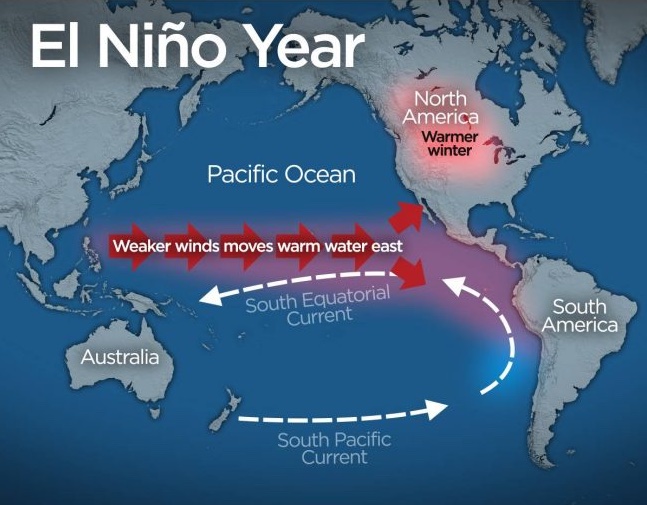
During El-Nino Year
- In an El-Nino year, air pressure drops over large areas of the central Pacific and South America’s coast.
- In such cases, the typical low-pressure system in the western Pacific is replaced by a weaker high-pressure system known as the Southern Oscillation.
- This alteration in the pressure pattern weakens the trade winds, leading to the formation of a Weak Walker Cell.
- Occasionally, the Walker Cell may even reverse direction. This weakening allows the equatorial countercurrent to gather warm ocean water along the coasts of Peru and Ecuador.
- Consequently, this warm water accumulation causes the thermocline to descend in the eastern Pacific, disrupting the upwelling of cold deep ocean water along the Peruvian coast.
